The Mind That Connects
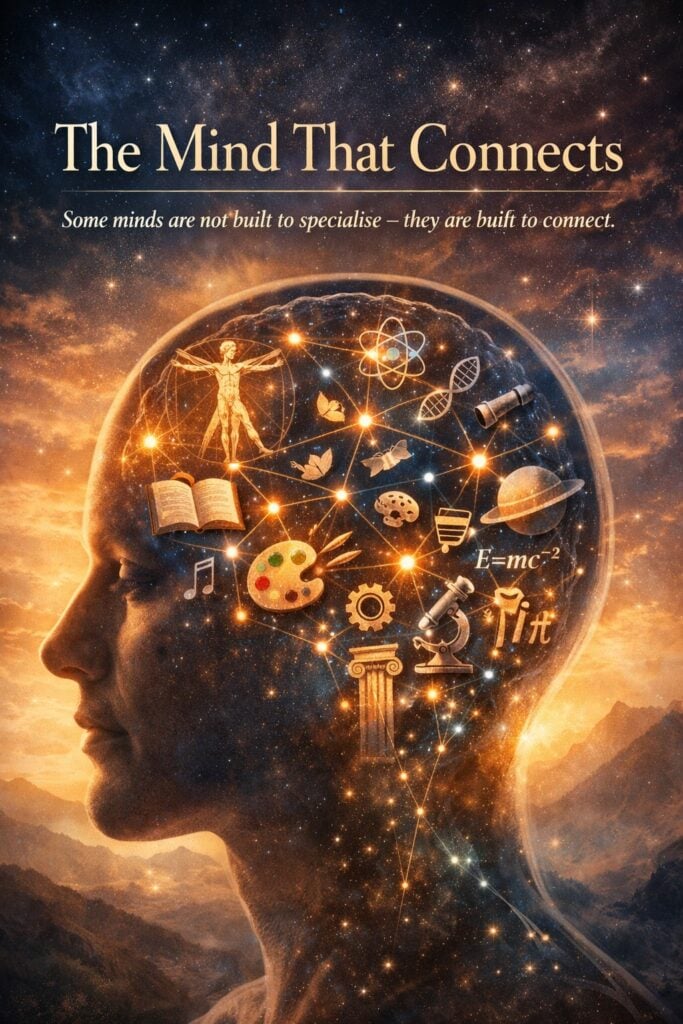
My primary school was unusual. We moved fluidly between music, art, drama, sport, and academics, and my mother encouraged me to try everything. I even started studying Latin at eleven. That early exposure, combined with the way my brain naturally works, meant I developed a curiosity that leapt across subjects and ideas.
As I grew older, the wider world began to demand something very different: specialisation. The expectation to pick a single path and stick to it – to go deep rather than wide – often felt like swimming upstream. What had once been celebrated curiosity now seemed scattered, even a little wrong. Only gradually did I begin to realise that this restlessness might not be a flaw at all. Perhaps it was a different way of thinking about knowledge itself.
This perspective helped me make sense of my own learning style. I discovered language for it: the polymath mind. A polymath is not merely someone who knows a little about many things, It is someone who learns broadly and deeply enough to see how ideas connect, to trace patterns across disciplines, and to integrate knowledge in ways that specialists rarely do. Curiosity is not scattered. It is directional, just not linear. Where specialists dig wells, polymaths build bridges.
My early education and my mother’s encouragement prepared me to think in patterns, to see relationships, and to integrate ideas. In a world increasingly defined by complexity and interconnection, these traits are powerful advantages.
Polymathy in Practice
Over time, I began to notice patterns in how my mind works. Rapid curiosity, a tendency to move between subjects, and a drive to connect ideas that at first seemed unrelated. These are traits often associated with ADHD. But framed differently, they can be seen not as a disorder or limitation, but as a natural alignment with polymathic thinking. In other words, some ways of being that the world sometimes labels “scattered” or “distracted” may simply be expressions of a mind built to explore, integrate, and innovate.
Historically, the polymath mind has produced figures who feel familiar to me. Leonardo da Vinci, for instance, embodies exactly the kind of thinking I recognise in myself: moving fluidly between art, anatomy, engineering, and observation of the natural world, drawing connections across disciplines with insatiable curiosity. I have always felt a resonance with his approach. Recognition of a way of thinking I relate to personally, as if in my innermost core.
This way of thinking feels increasingly relevant today. In a world that is both more complex and interconnected than ever, the ability to synthesise knowledge across fields is invaluable. Polymath thinking is not about knowing everything, nor about excelling in all areas. It is about noticing connections, tracing patterns, and integrating insights.
The Discipline of Breadth
Curiosity alone is not enough. A polymath mind requires its own kind of discipline. Exploration without reflection can become noise. Integration without attention can feel shallow. Learning broadly is valuable only when paired with the willingness to return, to linger, and to see how ideas connect. Revisiting subjects months later, applying them in new contexts, or simply noticing patterns across seemingly unrelated experiences allows breadth to become insight.
A Modern Polymath
Encouragingly, the world today seems to be rediscovering the value of this way of thinking. While narrow specialisation was paramount in industrial-age systems, the challenges of the twenty-first century – from technology and AI to social and environmental complexity – increasingly require synthesis, pattern recognition, and innovation. Our minds are needed not just to execute, but to connect, interpret, and reimagine.
Closing Reflection
In that sense, the resonance I feel with Leonardo da Vinci is more than admiration; it is recognition. His mind was not exceptional because he mastered every field, but because he noticed relationships others overlooked, and allowed his curiosity to travel freely between them. That same impulse to move, to connect and to integrate is reflected in my own experiences and in the growing relevance of polymathic thinking today.
Perhaps the question is not whether we should specialise or generalise. Both paths have value. But for those whose minds naturally seek connection, the reframing can be quietly liberating.
Curiosity is not a failure of focus.
Restlessness is not a flaw.
It can be a lens, a style of thought, a way of engaging with the world that is increasingly rare and increasingly valuable.
Some minds are not built to specialise. They are built to connect.




 Facets vs Fragments
  Retiring my Brand
  Living A Full & Flourishing Life
  What a Theatre Production Taught About Teamwork
  The Luke Drama: My Journey
  Controlled Turning not Wild Spinning